
How API-driven supply chains are powering modern customer experience

An order gets delayed, inventory data falls out of sync, and suddenly the customer experience begins to break down. For years, businesses treated fulfillment as a back-end operation built for stability, not adaptability. But as commerce becomes increasingly real-time, organizations are rethinking fulfillment as a connected, API-driven capability that can respond, evolve, and scale alongside customer expectations.
The supply chain has always been the ‘unglamorous’ backbone of commerce. Invisible when it works, catastrophic when it doesn't. For decades, businesses have accepted its rigidity as the cost of doing business. But now, that is changing.
The shift happening now is not just about faster shipping or better warehouse software. It represents a fundamental architectural shift: treating fulfillment not as a back-office operation, but as a programmable, customer-facing capability. This is the foundation of modern API-driven fulfillment architectures, and it is reshaping how enterprises compete today.
Traditional fulfillment systems were designed for a predictable, linear commerce environment where operational stability mattered more than adaptability. Order comes in, inventory gets pulled, package goes out. It worked when demand was stable, and customer expectations were far less demanding.
The advent of E-commerce broke both of those assumptions simultaneously. Order volumes became unpredictable, and customers started expecting speedy delivery from every retailer, regardless of size. The rapid expansion of digital commerce channels also meant fulfillment could no longer support a single operational pipeline. It had to orchestrate inventory, logistics, and delivery seamlessly across every channel simultaneously. The monolithic systems built for the old model could not stretch that far. They were too rigid, too siloed, and too slow to reconfigure when something changed. What businesses needed wasn't just an upgrade. They needed a fundamentally different fulfillment architecture built for adaptability, connectivity, and scale.
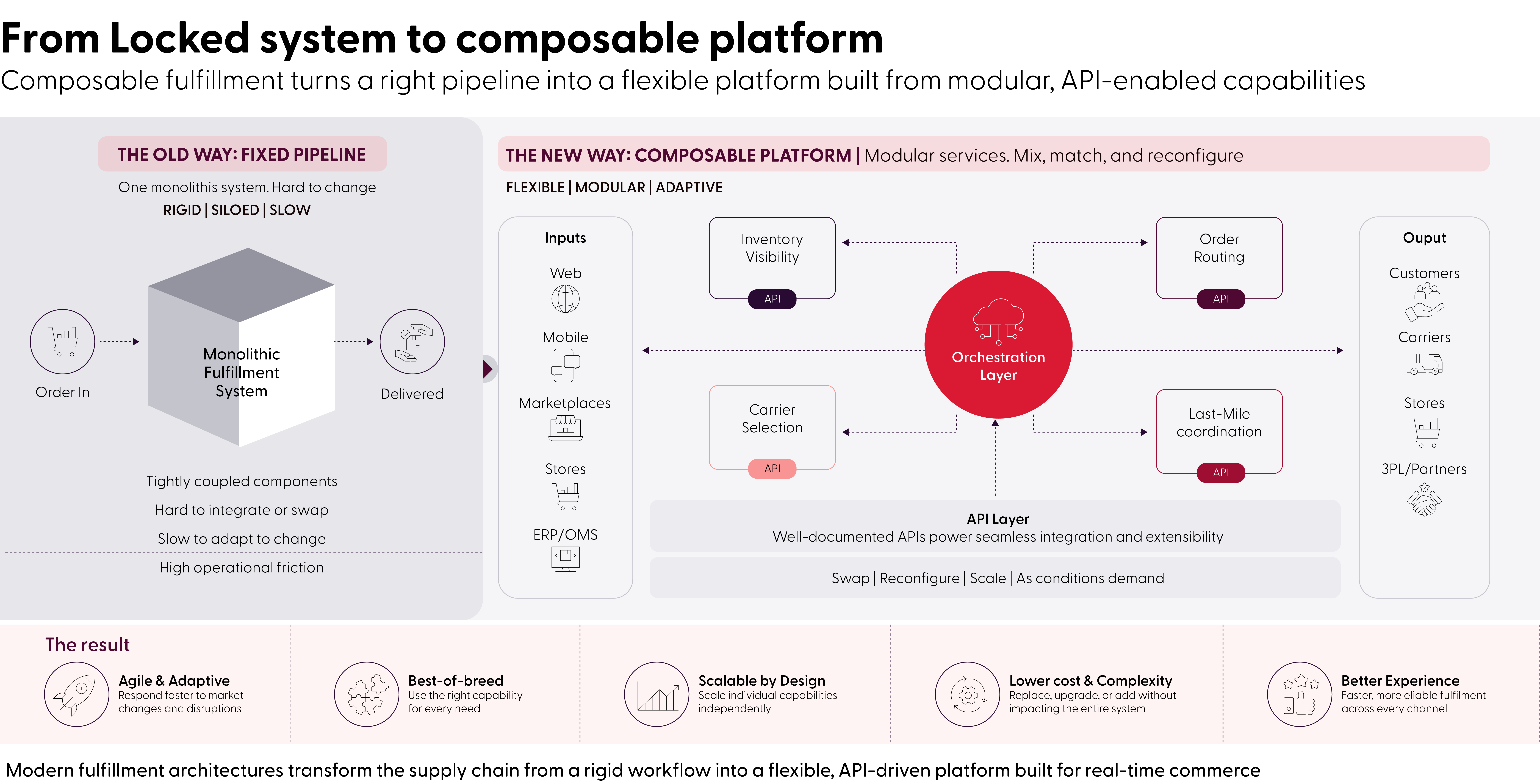
At its core, an API-driven fulfillment architecture breaks the supply chain into modular, independently deployable capabilities that include inventory visibility, order routing, carrier selection, and last-mile coordination, each of which is exposed through well-documented APIs. Instead of one locked system doing everything, you get a set of modular services that can be assembled, swapped, and reconfigured as conditions demand. The result is a supply chain that behaves less like a rigid pipeline and more like an adaptive, connected platform.
Composable fulfillment doesn't just move products faster. It moves experiences smarter.
The API-first approach fundamentally changes how fulfillment systems interact across the enterprise. When fulfillment capabilities are exposed through APIs, the supply chain becomes an interconnected operational layer that can seamlessly integrate with customer, commerce, and enterprise systems.
Now, your e-commerce front-end can query real-time inventory before confirming an order. The CRM can surface expected delivery windows without a manual lookup, and the logistics team can reroute shipments automatically in response to a carrier delay. All of this becomes possible because data that once lived in isolated systems behind manual processes is now accessible, actionable, and connected.
The basic intelligence of the supply chain, which is availability, timing, and fulfillment, can flow directly into every customer touchpoint, in real time, without friction. This shift is also becoming a major driver of supply chain digital transformation across modern enterprises.
At VRIZE, we increasingly see fulfillment modernization becoming less about replacing systems and more about orchestrating them intelligently. Enterprises are not looking for another monolithic platform. They are looking for architectures that can integrate existing investments, enable faster innovation, and adapt continuously as customer expectations evolve.
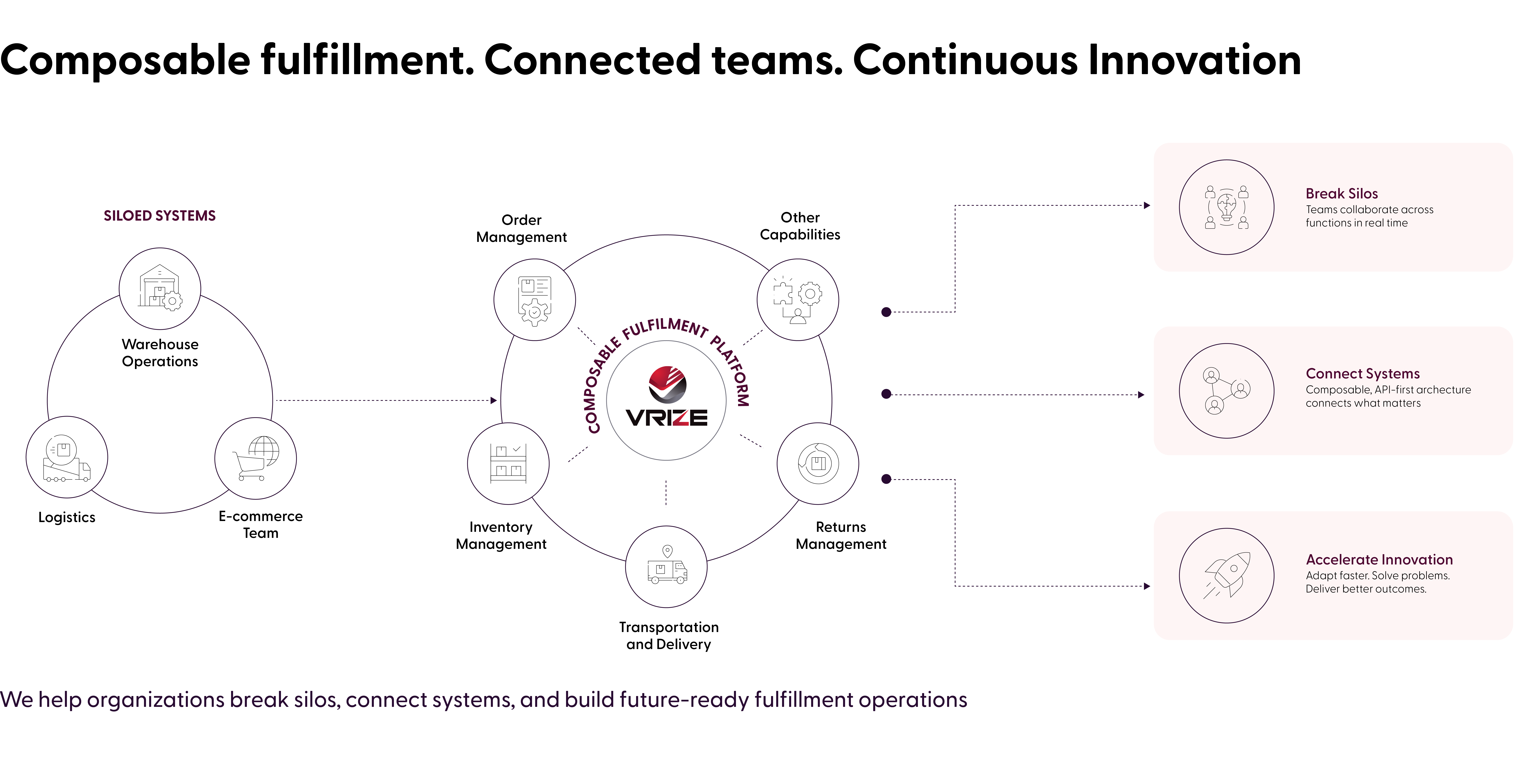
One of the most overlooked advantages of API-driven fulfillment architectures is what it does to the internal dynamics. Traditional supply chain systems tend to create hard boundaries between functions. Logistics owns one system, warehouse operations own another, and the e-commerce team works in a third. Cross-functional decisions often become operational bottlenecks that slow execution and limit responsiveness.
But when the underlying architecture is composable and API-driven, those boundaries become more porous. Teams can build on capabilities without waiting for the IT department to broker every integration. Operations teams can make targeted adjustments to specific components without triggering a system-wide change request. In short, the people who are closest to a problem can act on it faster.
This is where API-first fulfillment strategies become critical. At VRIZE, we help organizations modernize fulfillment operations by enabling architectures that improve connectivity, agility, and operational visibility across the supply chain ecosystem. This growing emphasis on connected and decentralized operations also reflects a broader enterprise shift toward breaking down data silos and enabling distributed decision-making, explored further in our article The rise of Data Mesh: Breaking silos for enterprise-scale analytics.
Across organizations where we have made this transition, an interesting pattern tends to emerge: teams that were initially hesitant about changing established workflows quickly begin finding new ways to combine capabilities and improve operations. Over time, this modular approach does not just make fulfillment faster but also easier and far less expensive. This is also why composable commerce models are increasingly influencing how enterprises rethink fulfillment and customer experience together
It would be easy to describe modern fulfillment transformation as a simple technology upgrade, but the reality is far more complex. For many, the transition involves rethinking long-standing processes, systems, and ways of working. And when that complexity is underestimated, the challenges tend to surface quickly.
Security is often the first major challenge. Once fulfillment systems are exposed through APIs and connected with multiple third-party platforms, there are simply more entry points that need to be protected. Every additional integration expands the security surface area, making governance, authentication, and API security critical components of the architecture.
Integration complexity can increase rapidly as independently evolving services and systems scale across the ecosystem. In a composable environment, different services are updated independently, and even a small change in one component can affect another. Without clear API standards and strong testing processes, flexibility can quickly turn into operational complexity.
Legacy systems also add another layer of difficulty. Most organizations are not starting from scratch but are working with existing ERP platforms, warehouse systems, and carrier tools that were never designed for modular, API-driven architectures. As a result, modernization often happens incrementally, with legacy and modern systems coexisting during the transition phase. That transition is often more expensive and time-consuming than organizations initially anticipate.
Moreover, modern fulfillment ecosystems work best when teams collaborate around shared business goals instead of operating in isolated functions. Without the right ownership models, workflows, and alignment across teams, even the best architecture can become fragmented over time.
The organizations that gain the most from modern fulfillment architectures are not necessarily the ones that move the fastest, but the ones that build the right foundation to scale consistently over time.
That foundation includes standardized API practices, so integrations remain stable and manageable as the ecosystem grows. It also requires clear ownership of every component, including accountability when issues arise. Strong data governance is also equally important, ensuring that every system operates from the same accurate, real-time information. Vendor and platform decisions must also support long-term interoperability and flexibility, preventing organizations from reintroducing operational rigidity.
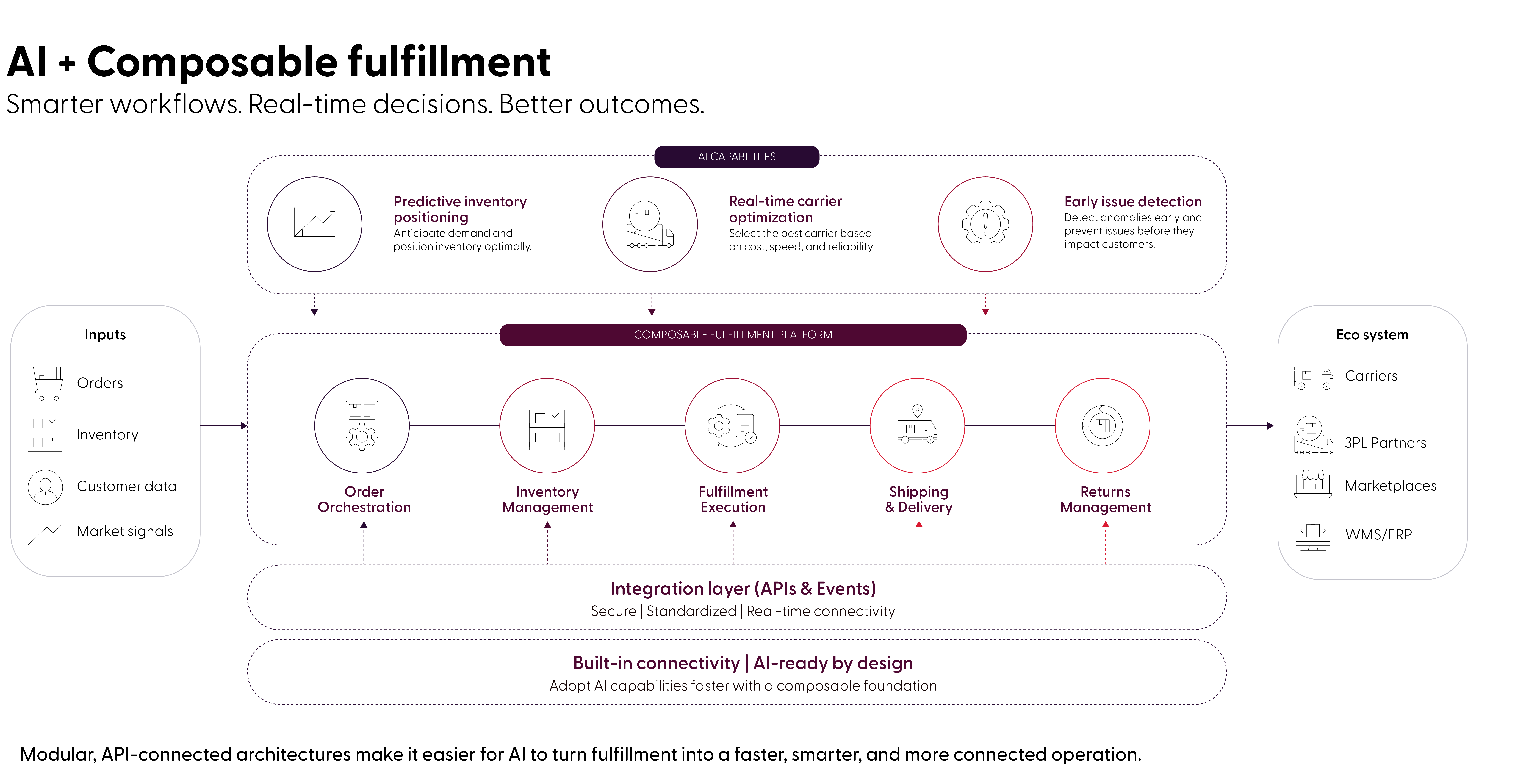
AI is rapidly becoming a core layer within modern fulfillment architectures. AI capabilities such as predictive inventory positioning, intelligent carrier optimization, disruption forecasting, and proactive issue detection are increasingly being embedded directly into fulfillment workflows. Organizations built on modular fulfillment architectures are able to adopt these capabilities more easily because the connectivity and integration layers are already in place. This growing convergence between APIs, AI, and logistics is also accelerating broader supply chain digital transformation initiatives across industries.
AI can also dynamically reroute shipments based on weather disruptions, regional demand spikes, or carrier capacity constraints, capabilities that become significantly easier within API-connected fulfillment ecosystems.
The next generation of commerce leaders will not be defined solely by delivery speed or logistics scale, but by their ability to build fulfillment ecosystems that continuously adapt to evolving customer expectations and operational demands.
The enterprises leading this shift are not necessarily rebuilding their supply chains from scratch. Instead, they are creating connected fulfillment ecosystems that unify APIs, data, automation, and operational intelligence into a more adaptive business model. This is where modern digital engineering becomes critical.
Modern fulfillment architectures create that adaptability. They allow businesses to integrate new capabilities without rebuilding entire systems and respond to disruption without slowing down the customer experience. More importantly, it shifts fulfillment from a back-end operational function into a strategic business capability that directly affects speed, flexibility, and customer trust.
As AI, automation, and connected commerce continue to evolve, fulfillment will no longer be measured solely by operational efficiency. It will be defined by adaptability. Enterprises that can orchestrate fulfillment dynamically across systems, partners, and customer touchpoints will shape the future of customer experience.
