
Workforce Sustainability in Aged Care Starts with Reducing Administrative Burden

Why solving the administrative crisis in aged care is inseparable from solving its workforce crisis, and why AI sits at the intersection of both.
There is a version of the workforce problem in aged care that gets discussed in policy meetings and a version that plays out on the floor of a residential facility. In policy discussions, the crisis is often demographic and financial: few workers, an ageing population, and funding models under pressure. On the floor, it is more specific. A caregiver who entered the profession for genuine human connection is spending the first 90 minutes of their shift on documentation before they have had a meaningful conversation with a single resident. By the end of the week, they’re probably considering whether the job is still worth doing.
Those two versions of the problem are the same problem. Workforce turnover remains one of the most significant challenges facing aged care providers globally, placing growing pressure on recruitment, retention, and continuity of care. Globally, the World Health Organization projects a shortfall of 10 million health workers by 2030, with aged care among the most acutely affected segments. The sector cannot find its way out of a structural crisis while the experience of working in it continues to drive people away. Administrative burden in aged care is therefore not a side issue in that equation but close to the center of it.
Regulatory frameworks governing aged care have grown considerably more demanding over the past decade, and largely for good reasons. Accountability, quality standards, and resident safety all depend on rigorous documentation, but what has not kept pace is investment in systems that make compliance less costly to deliver.
The architecture that resulted was built around manual processes and has never been fundamentally re-thought. Caregivers document because the system requires it, in formats the system specifies, using tools the system provides, none of which were designed with the caregiver's cognitive load or time constraints as the primary design consideration.
Faster data entry tools can reduce administrative effort, but they do not necessarily improve the experience of work. The providers making the strongest progress are focusing on how technology changes the caregiver's day: reducing interruptions, simplifying compliance tasks, and creating more time for direct resident interaction. The objective is not simply efficiency. It is making aged care a profession people want to remain in.
Early pilots and workforce modernization initiatives have reported meaningful reductions in documentation effort, scheduling friction, and administrative workload. While outcomes vary by organization and implementation approach, the broader pattern is consistent: when administrative burden decreases, caregivers gain more time for resident care and relationship-building.
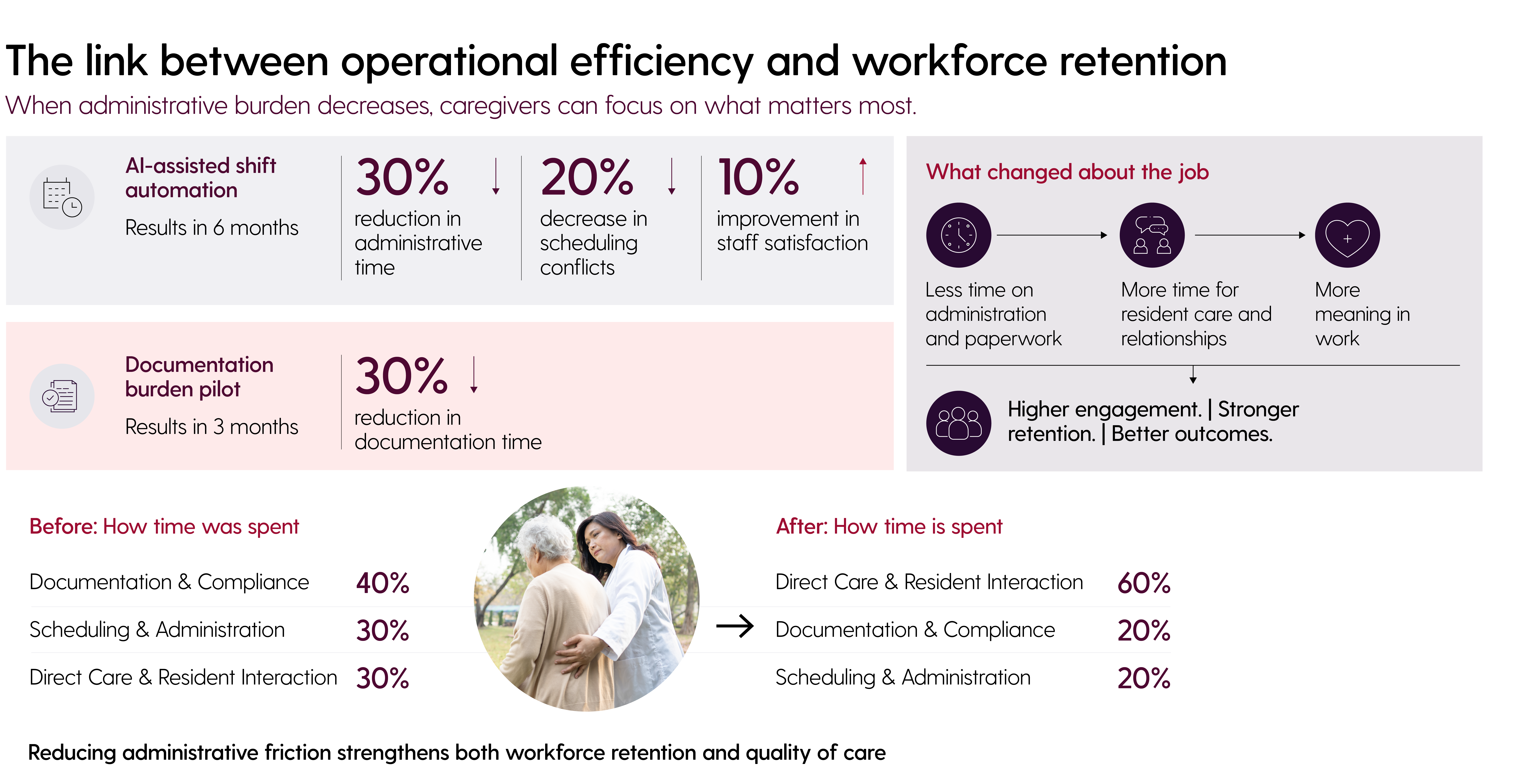
These figures are meaningful. But the more important finding embedded in them is what changed about the job itself. When caregivers spend less time on scheduling administration and compliance paperwork, the composition of their working hours shifts toward the interactions that drew them to the role. The efficiency gain and the retention argument are not separate benefits here, but the same outcome described from different perspectives.
Administrative burden creates costs that rarely appear in budget reports. When experienced caregivers spend increasing portions of their day on documentation and compliance activities, job satisfaction declines, burnout increases, and turnover becomes more likely.
The impact extends beyond recruitment costs. Every experienced caregiver who leaves takes with them institutional knowledge, resident familiarity, and trusted relationships that are difficult to replace. Workforce sustainability is therefore not simply a staffing issue. It is a continuity-of-care issue.
Reducing administrative burden improves more than productivity. It protects expertise, strengthens retention, and preserves the human relationships that sit at the center of quality aged care.
When AI is presented to aged care staff as an efficiency tool, it often attracts understandable skepticism because efficiency gains in care settings have historically translated into reduced staffing rather than improved conditions, and caregivers carry that memory.
The conversation changes when the focus shifts from efficiency to role quality. What would the job look like if the compliance overhead were halved? What if the shift started with resident care rather than documentation? And what if the data that caregivers generate through daily work were fed back into care planning rather than disappearing into reporting systems nobody reads?
Working closely with aged care providers on workforce and technology strategy, we have observed that the most successful implementations were designed around the activities the caregivers wanted to spend more time on. Teams were often involved in shaping the workflows rather than having them imposed as finished solutions. As a result, adoption was typically stronger than in organizations where technology was introduced primarily as a cost-reduction initiative. That shift, from AI as a productivity tool to AI as something that changes what a working day actually feels like is examined through real workforce data in our article The floor has moved: Rethinking work in an AI-First World.
Aged care carries a data sensitivity profile that itself demands particular care. Many aged care residents require additional safeguards around consent, privacy, and data governance, creating a higher threshold for trust than is found in many other technology deployment environments. Hence, the trust between residents, families, and care providers is foundational to the sector in a way that has no direct equivalent in most other healthcare settings.
Regulatory frameworks governing AI in aged care are still developing, and the gap between what is ‘technically deployable’ and what is ‘compliantly deployable’ is real. The most defensible path in this perspective, therefore, should be phased:
Speed in this context, however, is not a virtue.
The administrative burden in aged care will not be resolved by a single technology or a single reform since it requires regulatory simplification, workflow redesign, and AI tools that are genuinely integrated into how teams operate rather than added alongside existing processes as a mere additional obligation.
High-performing aged care providers no longer view this as simply a documentation problem. They are building toward a model where compliance happens continuously rather than retrospectively, where caregivers spend their time on the work that justifies the profession's existence, and where the data generated becomes an asset that improves future care rather than a burden imposed on the people delivering it in the present.
That model does not arrive quickly. But the distance between those that start building it now and those that address it only when the workforce pressure becomes unmanageable will not be a gap that technology alone can close.
The difference today is that the tools needed to reduce administrative burden already exist. The challenge is no longer proving that technology can help. It is deciding that caregiver time is valuable enough to redesign work around it.
Aged care has spent years discussing workforce shortages. The organizations making the strongest progress are focusing on a different question: how do we make the profession more sustainable for the people already doing the work?
Because every hour returned to care is more than an efficiency gain. It is an investment in workforce retention, resident experience, and the long-term resilience of the sector.
